
 English
  Dutch
Dutch 
Clean awnings help maintain a professional appearance at any business property. Organizations with multiple locations need a consistent approach. Dirt buildup affects the material, function, and lifespan. Regular maintenance prevents unexpected replacements and user complaints. Many facility managers look for clear guidelines on how to clean outdoor awnings. A structured method supports planning, execution and control. When cleaning becomes part of regular maintenance, the process becomes more predictable. This lowers costs over time. The property also remains representative for customers and employees. Cleaning requires no complex products, only attention and repetition. Consistent application keeps awnings functional and reliable in daily use.
Why regular cleaning is essential to professional maintenance
Awnings are constantly exposed to weather conditions. Dust, fine dirt and deposits adhere to the fabric. If left untreated, moisture can penetrate the material, increasing the risk of discoloration. In professional facility management, maintenance is all about prevention. Regular cleaning extends the lifespan without the need for major interventions.
The appearance of the building also plays a role. Business premises often serve as calling cards, the awning is one of the first elements customers notice. A dirty awning quickly creates an unkempt impression. By scheduling fixed cleaning moments in the maintenance plan, this remains manageable. This is especially important at locations with many visitors or passers by. Cleaning becomes a standard part of facility policy and aligns naturally with other maintenance cycles, such as façade cleaning or groundskeeping.
Preparation and inspection of the awning
Good cleaning starts with inspection. Check the fabric for tears, loose seams or discoloration. Examine mounting points and cassette too. This prevents existing damage from worsening during cleaning. Next, identify fabric type and construction. Manufacturer specs guide the right method.
Professional Armulux systems require maintenance matched to materials. Use lukewarm water and a soft brush. Avoid high pressure as it can damage the fiber structure. Clean with fabric fully extended for even access. Rinse thoroughly to remove residue. Let fabric dry completely before retracting. This preparation ensures controlled process without surprises.
Although there are a number of differences between an awning and a canopy, both should be cleaned in the same way to ensure a long lifespan.
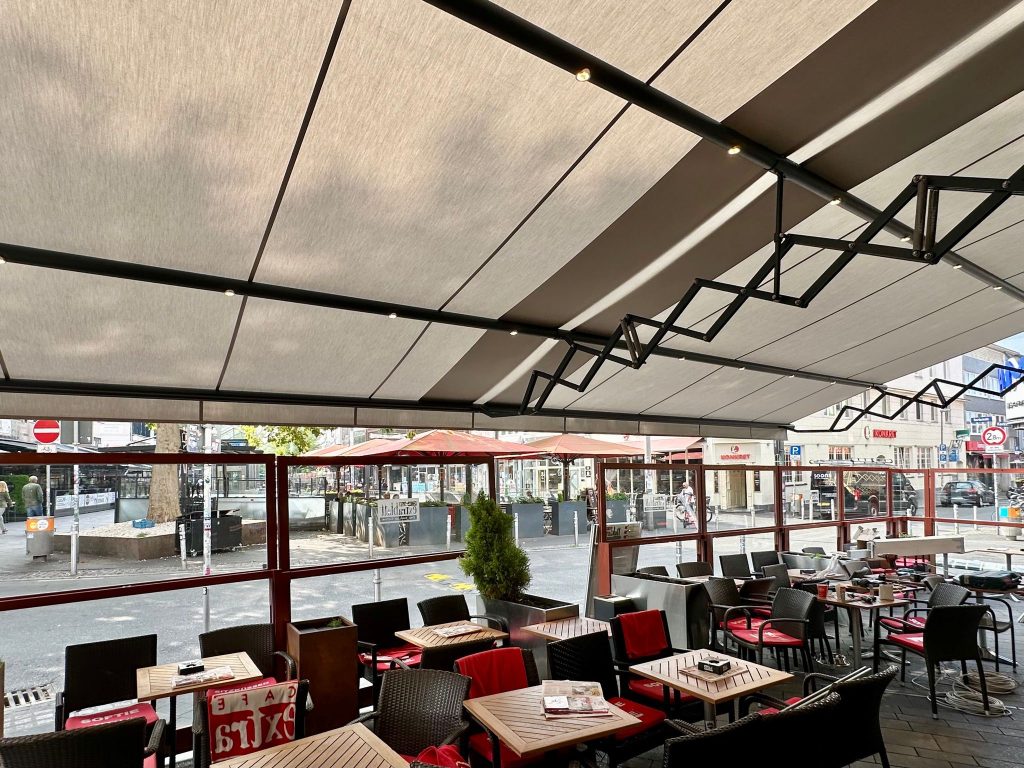
Applying the cleaning process step by step
After inspection, the cleaning itself begins. Always start at the top of the fabric. Work in consistent, straight passes to maintain oversight. This method ensures an even result. Keep the brush moving lightly; pressure is not needed to loosen dirt. Throughout the process, attention remains important. Check regularly whether the dirt is coming off. Rinse frequently to prevent loosened dirt from spreading. Clean the underside of the fabric as well, as fine dust often collects there. By treating the entire surface, the fabric stays balanced in appearance. Repeat these steps periodically. The frequency depends on the location and level of use. This way, cleaning outdoor awnings becomes a fixed part of operational maintenance.
Specific attention for the frame and moving parts
In addition to the fabric, the frame requires attention. Arms, hinges and mounting points collect dirt, which affects smooth operation. Clean these components with a damp cloth. Remove accumulated dust around moving parts. For systems with scissor arm awnings, this is even more important. The scissor mechanism contains multiple pivot points. Regular cleaning prevents stiffness. Check for unusual sounds or looseness at the same time. This way, cleaning combines visual inspection with functional monitoring, supporting continuous use without interruptions.
Maintenance as a standard part of facility policy
Structured maintenance requires documentation. By knowing clearly how to clean outdoor awnings and including cleaning in maintenance plans, continuity is ensured. This simplifies handovers between teams or suppliers. It also keeps track of when actions were performed. In B2B environments, reliability matters. Awnings function daily within operational processes. By making maintenance predictable, focus remains on core activities. Cleaning therefore supports not only the material, but the organization as a whole.
Would you like to enjoy your garden or balcony more? Then you may have heard of an awning or canopy. Both solutions offer shelter, comfort and a stylish look, but they have different applications and constructions. These solutions are popular forms of outdoor sun protection. But what are they exactly and which one is the solution for your outdoor space? Here you can read more about practical aspects, inspiration and our customised solutions.
What is an awning?
An awning is a sun and rain screen that is stretched by a fabric with arms and attached to a facade or window. The construction consists of an aluminium or steel frame and a fabric made of high-quality materials, such as acrylic or polyester. The fabric materials are resistant to UV radiation and various weather influences. This awning can be easily extended when the sun is shining or when it is raining, allowing your terrace guests to enjoy themselves regardless of the weather. Some modern versions are even electrically operated for optimal ease of use. This makes an awning ideal for catering establishments or other professional outdoor spaces.
What is a canopy?
Unlike an awning, a canopy is a freestanding or detached canopy, usually supported by poles that create a larger shaded area. The main advantage of a canopy is its flexibility in placement. This product does not necessarily have to be attached to the facade of a building or window, but can be placed centrally in a garden, above a terrace or at an event site. Without direct attachment, a canopy provides the desired shade in any location.
The construction of a canopy is usually slightly more robust and it has a sturdier frame. Whereas an awning is mainly installed horizontally, a canopy can also be set up vertically to protect the space from low sun or strong wind.
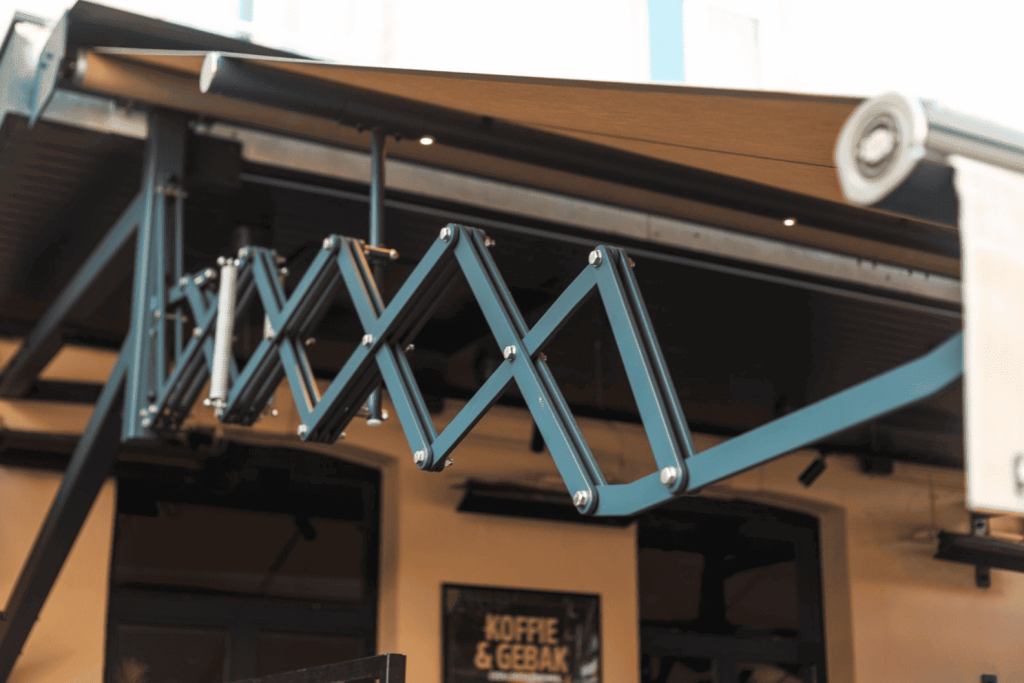
Awning vs canopy: what are the differences?
The main difference between an awning vs canopy has to do with the construction and installation. An awning is always attached to a fixed surface, such as a wall or window. A canopy, on the other hand, stands on its own. Its construction is based on several poles or posts, providing a large, freestanding canopy. In practice, an awning takes up very little space and is easy to extend at any time. A canopy, on the other hand, takes up slightly more space, but is more flexible in terms of placement, as it is not tied to a fixed location. In addition, canopies are often extended with side walls, screens and sometimes even lighting and heating.
Application and ease of use
Both awnings and canopies offer enormous functional advantages in everyday use. An awning is the perfect solution for creating simple shade. The fold-out system ensures that the outdoor space can remain flexible and open when protection from rain, wind or sun is not needed. Catering establishments with limited outdoor space can benefit greatly from an awning, as it takes up minimal space.
A canopy, on the other hand, offers many advantages for larger terraces or outdoor activities. The surface area of the fabric is larger and can therefore also serve as a kind of outdoor room. Ideal for large hospitality terraces, swimming pools or places with multiple seating areas.
To extend the lifespan of both, it is important that you clean both the awning and the canopy regularly. Read here to find out the best way to do this.
Design and branding
At Armulux, both awnings and canopies are available in various styles, colours and materials. From sleek and minimalist designs to colourful styles with company logos. The many design options make canopies and awnings real eye-catchers. They are a statement piece in any outdoor space or hospitality terrace. With an awning or canopy, you can create a unique outdoor space that can be fully customised to your wishes and requirements. Most sun and rain protection systems can also be equipped with innovative accessories, such as dimmable lighting, built-in speakers or heating elements.
Which solution is best for you?
Now that you know more about awnings and canopies, you may be wondering which option is best for your patio. Take a good look at the available space and make a list of your wishes and requirements. Ask yourself whether you are looking for functional protection against direct sunlight, or whether you value the flexibility of a freestanding canopy more. Whichever you choose, both solutions are available in a variety of sizes and formats.
Are you interested in upgrading your outdoor space or patio? Then contact us for more information about our wide range of our expertise in customisation. Whether you choose an awning or canopy, both products are extremely versatile, high-quality and user-friendly. Find out more about our options!